- Drive Central Islip, NY 11722
- centralislipgutters@gmail.com

Your gutters work every time it rains, whether you think about them or not — but only if they’re clear. Regular cleaning heads off roof leaks, foundation issues, and the kind of water damage that starts small and doesn’t stay that way.
Whether it’s been one season or a few years since your gutters were last touched, Central Islip Gutter is ready to help. Get in touch and let’s get it handled before the next storm rolls through.
4782 Melville Street Memphis, TN 38118
11 Mar, 2026
Gutter Cleaning
Nobody thinks about their gutters until they fail. Then it’s water streaking down the siding, mulch washed halfway across the yard, or a damp patch in the basement that definitely wasn’t there last fall. Ronkonkoma gets its share of both — heavy summer downpours and real snow load come winter — so a gutter system that actually does its job isn’t a luxury here, it’s just part of owning the house.
That’s why so many homeowners in the area are moving away from old sectional gutters and into seamless ones. A sectional system is built from short pieces joined end to end, and every joint is a place a leak can eventually start — it’s just a matter of time. Seamless gutters get around most of that. They’re formed on the spot to match your roofline in one continuous piece, so the only joints left are the ones you can’t avoid, like corners and where the downspouts hang.
If you typed “seamless gutters near me” into Google to get here, you’ve probably already dealt with enough patch jobs. What you actually want is something built for your house that you don’t have to think about again for another decade.
It’s in the name — there’s no seam running the length of the gutter. Instead of snapping together pre-cut sections with connectors and sealant, a crew shows up with a portable forming machine, measures your roofline, and shapes each run right there on-site.
Fewer joints means fewer places for water to slip out and fewer little ledges for leaves and grit to grab onto. It also just reads cleaner along the roofline — no visible seams breaking up the line.
Aluminum is what most people end up going with. It doesn’t rust, it’s light enough that it won’t put stress on your fascia over the years, and it takes Long Island weather in stride without needing constant babying. Put that material into a seamless run and you get a system that’s actually low-maintenance — not the kind of “low-maintenance” that’s just a line in a brochure.
Twice a year covers most homes — spring and fall. If you’ve got a lot of trees nearby, check in every few months instead.
It depends on your home’s size, roof height, gutter length, and how much debris has built up. Reach out and we’ll give you a straight number based on your actual property.
Yes. Overflow that repeatedly pools at the base of your house can erode soil, cause settling, and in some cases lead to basement leaks.
Every visit includes checking and flushing downspouts — a clean gutter with a blocked downspout doesn’t actually solve the problem.
For most homeowners, yes. It’s the safety equipment, the tools that clear a real clog, and having someone experienced catch small problems before they become expensive ones.
Yes — we’re fully licensed and insured, so you’re protected on every job we do.
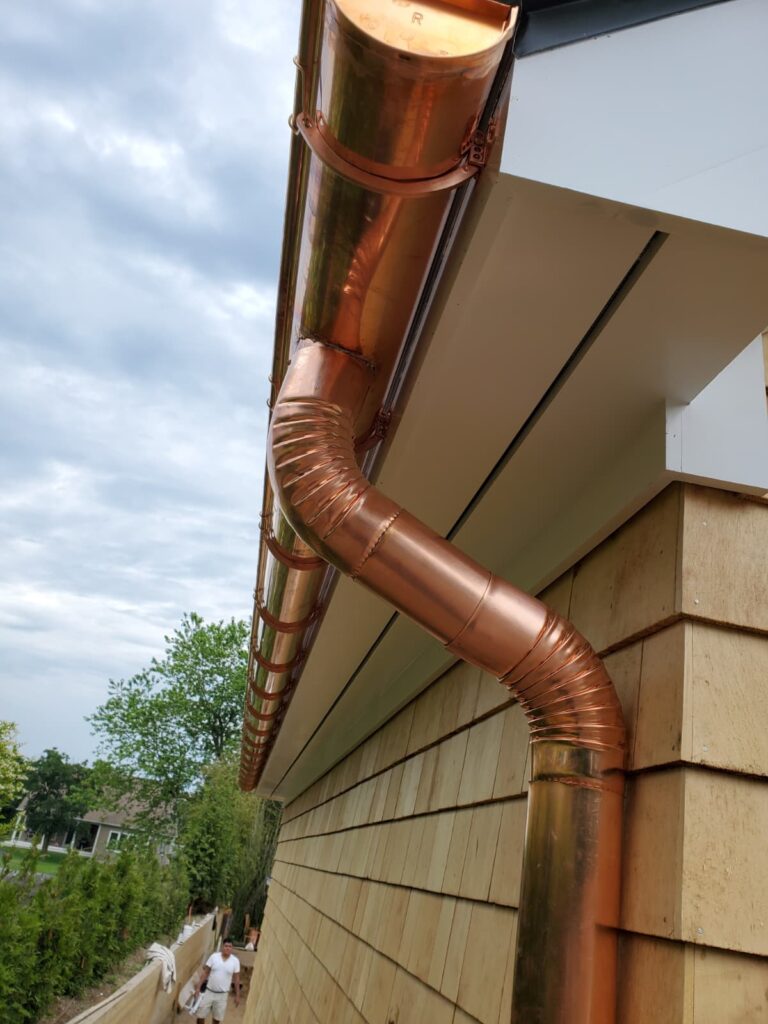
Fewer joints means water gets to the downspout instead of dripping out somewhere along the way, which matters a lot more than it sounds like the first time a real storm rolls through and your foundation stays dry instead of sitting in a puddle.
There’s a look to it too. A seamless run follows your roofline without the visual break of connector joints every few feet, and you can match the color to your trim so it doesn’t stand out as an obvious add-on.
And honestly, the maintenance side is what wins over most homeowners once they’ve lived with it a season. Fewer seams means fewer spots for debris to snag, so cleaning takes less time and needs to happen less often — especially if you add gutter guards on top of it. That doesn’t mean zero maintenance. It still needs a look after a bad storm and a clean-out in spring and fall. It’s just a fraction of what a sectional system demands.
Everything starts with measuring — roofline length, the right slope for drainage, where the downspouts need to land so water clears the foundation instead of pooling right next to it. Get the slope wrong and none of the rest matters.
From there, each section gets formed on-site to match, hung with hangers rated to carry the weight of a full run of water plus wet leaves plus whatever winter throws at it. Skimp on hanger spacing and you’ll see sagging in a couple of years, guaranteed. Last step is running water through every downspout to confirm it’s actually clearing the house, not just looking fine from the ground.
Done properly, it’s not “gutters bolted to a roof” — it’s a system built to survive an actual New York winter, not just look good the day it goes up.
Aluminum is the default for most homes, and it earns that spot honestly — affordable, rust-proof, comes in enough finishes to match almost any siding, and light enough that it’s not putting strain on your fascia boards year after year.
Copper is gorgeous, and it’ll genuinely outlast the house in some cases, but the price tag puts it out of reach for most standard residential jobs. Steel holds up fine structurally until the coating gets nicked, and then rust creeps in. Vinyl’s the cheapest option on day one but goes brittle in cold weather faster than people expect.
For most homes around here, aluminum still wins on the mix of price, durability, and how little you have to think about it afterward. Worth a real conversation with a local installer, though — your roofline and budget might point somewhere different.
Gutters give you warning signs before they actually fail. Keep an eye out for:
See two or three of those at once and you’re past the point where another patch job makes sense.
Waiting doesn’t usually save money, either. A leak that gets ignored for a season can turn into rotted fascia, foundation erosion, mold, a washed-out flower bed — and none of that is cheap to fix compared to just replacing the gutter before it gets there.
It looks simple enough — until you’re the one on the ladder trying to eyeball the slope. Too flat and water sits there instead of draining. Too steep and it rushes past before it can actually work. Space the hangers too far apart and the whole run sags the first time it’s carrying real weight.
A crew that does this for a living brings the fabrication equipment, already knows what slope your specific roofline needs, and places downspouts where they’ll actually keep water off your foundation instead of wherever’s easiest to reach. That’s really the gap between a system that’s still working fine in twenty years and one you’re re-fixing every couple of seasons.
Price comes down to your roof size, how many corners and downspouts are involved, the material, and how easy or hard your roofline is to access. A two-story home with a complicated roof is naturally going to run more than a straightforward single-story ranch.
It’s tempting to just go with whoever quotes the least. But thin materials and rushed installs tend to show up as leaks and sagging within a couple of years, and fixing that costs more than doing it right the first time would have. Good seamless gutter work basically pays for itself by not needing to be redone.
Even seamless gutters aren’t a “set it and forget it” thing. A quick look each spring and fall — clearing out whatever’s collected, making sure the downspouts are actually flowing, checking for loose fasteners after a rough storm — heads off most of the problems before they start.
If climbing a ladder isn’t how you want to spend a Saturday, a professional cleaning once or twice a year does the same job. And if something small turns up while they’re up there — a loose bracket, a gap starting at a joint — getting it fixed on the spot is a lot cheaper than waiting for it to turn into a full replacement down the road.
Every house here is a little different — different roofline, different tree cover, different quirks in how water actually wants to drain off the roof. So we measure and build around your specific house instead of running the same template on every job.
If you’ve been searching for a seamless gutter company or gutter work near me in Ronkonkoma, what you’re actually looking for is someone who shows up when they say they will, gets the install right the first time, and stands behind it afterward. That’s really the whole pitch — straightforward communication, a schedule we stick to, and a job site that’s clean when we leave.
New build, full replacement, or just routine cleaning and the occasional repair — the goal’s the same either way: a gutter system you stop thinking about because it’s just working.
Looking for reliable gutter services in Central Islip, NY? Central Islip Gutter is your trusted local company for professional gutter installation, gutter repair, gutter cleaning, gutter guards, and maintenance. We proudly serve homeowners and businesses throughout Central Islip, Islip Terrace, Brentwood, Hauppauge, Bay Shore, East Islip, West Islip, Bohemia, Ronkonkoma, Smithtown, Holbrook, Deer Park, Commack, Sayville, Oakdale, Babylon, North Babylon, West Babylon, Brightwaters, and surrounding Long Island communities.
Our experienced team is committed to providing quality workmanship, dependable service, and long-lasting gutter solutions that protect your property year-round. Whether you need routine maintenance or a complete gutter replacement, we’re here to help.
Contact us today for a FREE estimate!
🌐 Website: https://centralislipgutter.com/
📞 Phone: (631) 398-0901
📧 Email: centralislipgutters@gmail.com
📍 Location: Islip Terrace, NY
Serving Central Islip and surrounding areas across Long Island with professional, affordable, and dependable gutter services.
(631) 398-0901
centralislipgutters@gmail.com
Drive Central Islip, NY 11722
Developed By Flash Digital LLC